Housing Allowance 2026: Who Qualifies, How Much You Get and How to Apply
by Housemaster on 15 October 2026

The housing allowance is a monthly payment of €70 to €210 for low-income households that rent their main home. It is paid by OPEKA, on an application made by the tenant.
It is not automatic. You need a lease declared to AADE, income and assets below specific limits and five years of legal residence in Greece. Approval lasts six months, and after that you file a new application.
Below you will find what applies in October 2026, with worked examples.
At a glance
- What it is: a monthly rent allowance for your main home, paid by OPEKA (article 3 of Law 4472/2017 and joint ministerial decision 71670/2021).
- Amount: €70 for the applicant, +€35 for each additional member, up to €210 a month. Never more than the rent.
- Income limit: €7,000 for a one-person household, +€3,500 per member, up to €21,000 a year.
- Real estate: up to €120,000 taxable value for one person, +€15,000 per member, up to €180,000.
- Residence: 5 years of legal and permanent residence in Greece (12 years for third-country nationals, with exceptions such as ethnic Greeks and refugees).
- Payment: on the last working day of each month. The October 2026 payment is made on Friday 30 October.
- Duration: 6 months per approval, with no automatic renewal. It is tax-free and cannot be seized.
What is the housing allowance and who pays it?
The housing allowance is a social welfare benefit that subsidises the rent of a main home. It is paid by OPEKA, from the state budget.
The legal basis is article 3 of Law 4472/2017. The terms, amounts and procedure are set by joint ministerial decision 71670/27.9.2021 (Government Gazette (FEK) B 4500/29.09.2021), which replaced the original 2019 decision.
It is often also called the "rent allowance". But do not confuse it with AADE's annual rent refund, which is a different measure with other criteria.
Who qualifies for the housing allowance?
Eligible households are those living in a rented home as their main home that meet the income, asset and residence criteria. The application is made by the person named as tenant on the lease.
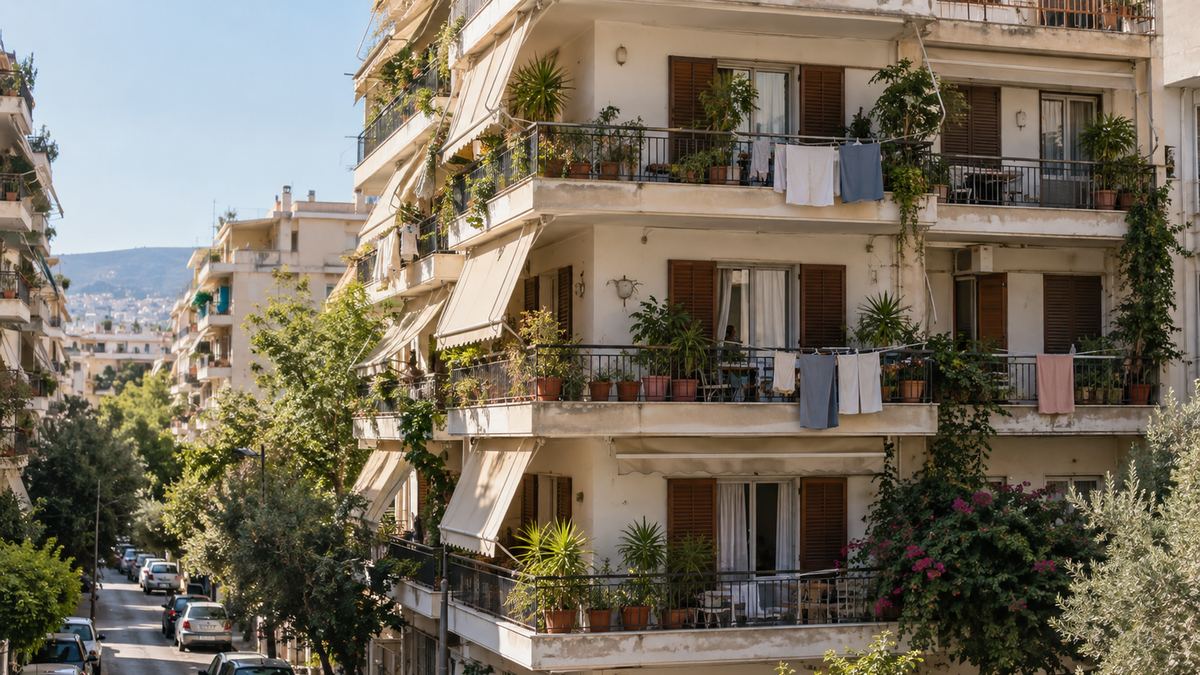
A household is either one adult living alone or several people living together. The household can also include hosted persons, as long as the hosting has been declared in the latest assessed tax return.
What applies to students?
A student up to 25 years old cannot apply for the housing allowance on their own, even if they rent a home in the city where they study. They count as a member of their parents' household, regardless of where they live.
They can be included in their parents' application, if the parents rent their main home. For the rent of student housing there are other measures: the Ministry of Education's student housing allowance (stegastiko.minedu.gov.gr) and the rent refund for student housing.
Can a hosted person apply?
No. A hosted person has no lease of their own, so they cannot apply independently. They can, however, be counted as a member in the application of the household that hosts them, as long as the hosting has been declared on the E1. In that case, the application is filed by the person liable for the tax return or their spouse on behalf of everyone.
What about flatmates and co-tenants?
If two or more people are co-tenants on the same lease, one applies and the other is included as a member of the household. If each flatmate has a separate lease for part of the same home, the case is excluded.
What are the conditions for the housing allowance?
You must meet income, asset and residence criteria at the same time, have an electronically declared lease and not fall under an exclusion. If one criterion fails, the application is rejected.
What are the income limits?
The household's total annual income cannot exceed €7,000 for a one-person household, increased by €3,500 for each additional member. The absolute maximum is €21,000, however many members the household has.
In a single-parent family the first minor counts double (€7,000 instead of €3,500). The same increase applies to each "unprotected child", meaning a minor orphaned of both parents or a minor whose custody has been granted by a court to a household member.
| Household | Maximum annual income |
|---|---|
| 1 member | €7,000 |
| 2 members | €10,500 |
| 3 members or single parent with 1 minor | €14,000 |
| 4 members or single parent with 2 minors | €17,500 |
| 5+ members or single parent with 3+ minors | €21,000 |
Income means the actual or deemed income of all members from every source, before tax and after social security contributions, as shown in the latest assessed tax return. Benefits and tax-free income also count. Child benefit, non-contributory disability benefits and the foster care allowance are not counted.
What are the real estate limits?
The total taxable value of the household's real estate, as taken into account for ENFIA (the annual property tax), cannot exceed €120,000 for a one-person household. The limit increases by €15,000 for each additional member, up to a maximum of €180,000.
Is there a limit on deposits?
Yes, but it is checked indirectly, through the deposit interest declared on the E1. Annual interest cannot exceed the deposit limit × the average annual deposit interest rate / 100.
The limits on deposits (and shares, bonds, etc.) follow the income scale: €7,000 for one person, €10,500 for two, up to €21,000 for five or more members.
Which expenses exclude you?
The application is rejected if, according to the latest assessed E1, any member:
- is subject to the luxury living tax,
- pays crew wages for a pleasure boat,
- pays private school fees above €1,500,
- declares expenses for domestic helpers, drivers, private tutors or other staff.
How many years of residence in Greece are needed?
The applicant must have resided legally and permanently in Greece for the last 5 years before the application. Residence is proven mainly by tax returns filed on time for the relevant years or by other suitable documents.
Third-country nationals (outside the EU, EEA and Switzerland) need 12 years. Exempt from the 12-year limit, so that 5 years are enough, are ethnic Greeks holding a Special Identity Card for ethnic Greeks, refugees and beneficiaries of subsidiary protection, stateless persons and those with a residence permit on humanitarian grounds. The other household members must also reside legally and permanently.
What applies to the lease and the electricity?
The lease must have been declared electronically to AADE and accepted. It must be valid on the date of the application and for the entire six months for which you will receive the allowance.
In addition, the electricity supply contract for the home must be in the name of the applicant or another household member.
If the lease expires within the six months, ask the landlord to declare an amendment or extension to AADE before you apply. If you are a landlord and plan to list your property for rent, declaring the lease on time makes a difference for your tenant.
Is there a condition for school-age children?
Yes. If the household includes minors in compulsory education, they must be enrolled in school for the current school year and have had sufficient attendance in the previous one.
Who is excluded from the housing allowance?
You are excluded, even if you meet the financial criteria, when the household:
- is enrolled in another rent subsidy or rent coverage programme (e.g. "Kalypsi" or "Housing and Work"),
- rents a home without an electricity supply,
- rents part of a home rather than the whole of it,
- rents from a first-degree relative by blood or by marriage (e.g. a parent, child, father-in-law or mother-in-law), a spouse, former spouse or a person with whom they have a civil partnership,
- rents a home that had been declared as provided free of charge in the 3 years before the application.
Leases with a monthly rent below €10 are not accepted.
How much is the housing allowance?
The housing allowance is €70 a month for the applicant and increases by €35 for each additional member, up to a maximum of €210. If the rent is lower, you get an amount equal to the rent.
In a single-parent family the first minor adds €70 instead of €35. The same applies to each unprotected child.
| Household composition | Monthly allowance | Annual (12 months) |
|---|---|---|
| 1 member | €70 | €840 |
| 2 members | €105 | €1,260 |
| 3 members or single parent with 1 minor | €140 | €1,680 |
| 4 members or single parent with 2 minors | €175 | €2,100 |
| 5+ members or single parent with 3+ minors | €210 | €2,520 |
The annual amounts assume that you are approved in both six-monthly applications.
How is it calculated in practice? Worked examples
You find the amount from the household composition and take the lower of that and the monthly rent.
Example 1: one-person household
Eleni lives alone, pays rent of €380 a month and her income on her latest E1 was €6,400. She owns no property.
- Income €6,400, below the €7,000 limit.
- Amount: €70 a month, so €420 for the six months.
Example 2: family of four
A couple with two children rents a flat for €550 a month. Total family income is €16,800, and the taxable value of a small field they own is €20,000.
- Income limit: €7,000 + 3 × €3,500 = €17,500, so €16,800 passes.
- Real estate limit: €120,000 + 3 × €15,000 = €165,000, so €20,000 also passes.
- Amount: €70 + 3 × €35 = €175 a month, so €1,050 for the six months and €2,100 a year with two approvals.
Example 3: single-parent family and low rent
A mother with two minor children has an income limit of €7,000 + €7,000 + €3,500 = €17,500 and an amount of €70 + €70 + €35 = €175. But if she pays rent of €150, the housing allowance is capped at €150 a month.
How do you apply for the housing allowance?
The application is filed online through gov.gr, in the "Housing allowance" service, with the tenant's TAXISnet credentials. Alternatively, you can go to the relevant services of your municipality or to your local Community Centre.

Single-parent families and households with unprotected children apply only through the municipality or a Community Centre.
Application steps
- Go to the "Housing allowance" service on gov.gr and log in with your TAXISnet credentials.
- Check the details that appear automatically (tax number AFM, social security number AMKA, address).
- Select "New application" and declare the household members.
- Enter the lease declaration number and the electricity supply number.
- Enter your email, mobile number and the IBAN of an account of which you are the holder or a joint holder.
- Submit and track the status of the application on the platform.
You can find the lease declaration number on the submission receipt or in myAADE. All adult members must have filed a tax return.
The details are cross-checked electronically with AADE, EFKA, HEDNO (DEDDIE) and other bodies. If a mismatch is found, the application stays pending until you provide supporting documents.
After approval you can change only contact details, address and IBAN. Household members cannot be changed by amending the application.
When is the housing allowance paid?
The housing allowance is paid once a month, on the last working day of the month (article 22 of Law 4659/2020), by deposit to the IBAN on the application.
The October 2026 payment is scheduled for Friday 30 October and covers approved applications filed up to and including 30 September.
Entitlement starts on the 1st day of the month after the application. If you apply in October and are approved, the first payment is made at the end of November.
Without an IBAN that matches your tax number (AFM), no payment is made.
How often do you need to renew the application?
Approval lasts 6 months and is not renewed automatically. To keep receiving the housing allowance, you file a new application once six months have passed since the approval decision, which in practice means within the last month of the current six-month period.
The six-month duration is set explicitly by article 11 of the joint ministerial decision. A 12-month duration applies only to those leaving the "Housing and Work" and "Kalypsi" programmes.
With the new application all criteria are checked again, and you need a lease covering the entire next six months. If you are late, you lose a payment, because entitlement starts from the month after you apply.
What do you do if you move or your family changes?
If you stop renting the home on the application or move abroad, you must request revocation of the approval from the municipality or the Community Centre. For a new home you need a new lease declared to AADE and a new application. If you do not report changes affecting your entitlement in time, amounts you were not entitled to are reclaimed or offset.
Can you get both the housing allowance and the rent refund?
As a rule, yes, as long as you meet the criteria for each. Neither article 70 of Law 5217/2025 nor the allowance's joint ministerial decision makes them incompatible; the decision excludes only those enrolled in another rent subsidy programme.
| Housing allowance | Rent refund | |
|---|---|---|
| Body | OPEKA | AADE |
| Frequency | Every month | Once a year (November) |
| Application | Yes, every 6 months | No, automatic |
| Amount | €70–€210 a month | One month's rent, up to €800 (+€50 per child) |
| Income limit | €7,000–€21,000 | From €25,000 (single) upwards |
| Student housing | No | Yes |
Anyone who qualifies for the housing allowance usually also meets the income criteria for the rent refund.
Is the housing allowance taxed or seizable?
No. Under article 3 of Law 4472/2017, the housing allowance is not considered income and is exempt from taxes, fees and contributions. It cannot be seized, it is not offset against debts and it is not counted towards the income limits of the Guaranteed Minimum Income and child benefit.
Why can the housing allowance be rejected or stopped?
The usual causes are exceeding a limit, a lease that does not cover the whole six months or a mismatch in the household details. The reasons appear on the platform with the status "Not Approved".
| Cause | What to check |
|---|---|
| Income above the limit | Total income of all members on the latest assessed E1 |
| Lease expiring earlier | Lease duration in myAADE |
| Renting from a parent or child | Renting from a first-degree relative is excluded |
| Electricity in a third party's name | The electricity bill must be in a household member's name |
| Insufficient residence | Tax returns filed on time for the last 5 years |
| Member mismatch | Hosted persons or members not correctly declared on the E1 |
Payment is suspended automatically when cross-checks show a mismatch. You have until the end of the second month after the suspension to provide information.
If the mismatch is confirmed, the approval is revoked and a new application is allowed after 6 months. For duplicate applications or falsified details the exclusion is 5 years. Amounts paid without entitlement are reclaimed.
What changed in the housing allowance in 2025–2026?
The basic amounts and limits have not changed: €70–€210 a month and €7,000–€21,000 income. The developments concern the procedure and special cases.
- No automatic extensions: in the past, emergency extensions were granted (e.g. in 2024 for wildfire victims in Attica). Today a new application is required every 6 months.
- After the "Kalypsi" programme: under article 55 of Law 5322/2026 (FEK A 117/24.07.2026), those leaving "Kalypsi" after their entitlement ends can receive the housing allowance for up to 12 months, with special amounts of €225 (1 person), €262.50 (2 people) or €300 (3+ people) and not more than the rent. Conditions: a new lease in force within 6 months of leaving and for the whole 12 months, and an application on a special gov.gr platform. The usual income, asset and residence criteria do not apply. More detailed terms may be set by joint ministerial decision.
- An increase that never happened: in September 2024 an increase in the basic amount was announced, but the amounts OPEKA applies remain the same.
- Thessaloniki International Fair 2026: the September 2026 announcements do not concern the housing allowance, but mainly the rent refund, "Spiti mou III" and social housing.
From 1 July 2027 (decision A.1187/2026) rent must be paid into the landlord's bank account. Under article 210 of Law 5222/2025, a tenant who does not comply loses any state support or allowance for the lease.
What should you check before you apply?
Before you apply for the housing allowance, make sure that:
- the lease is declared and accepted by AADE and is valid for the next 6 months,
- you are the tenant and the landlord is not a first-degree relative or (former) spouse,
- the electricity bill is in your name or a household member's name,
- all adult members have filed a tax return,
- income, deposits and real estate are below the limits,
- you have tax returns filed on time for the last 5 years,
- the IBAN is for an account of which you are the holder or a joint holder,
- you have noted when the approval expires, so you can file a new application on time.
If you are looking for a home now and want to keep the rent at a reasonable level, you can browse homes for rent up to €600 in your area. Before you sign, ask the landlord to commit to declaring the lease to AADE.
Frequently asked questions
What is the income limit for the housing allowance for a single person?
For a one-person household the limit is €7,000 total annual income. The income on the latest assessed tax return is taken into account, before tax and after social security contributions.
How much is the housing allowance for a family of four?
For a family of four the allowance is €175 a month (€70 + 3 × €35), as long as the rent is at least that much. The income limit is €17,500 a year.
Can I get the housing allowance if I rent from my parents?
No. Renting from a first-degree relative, spouse, former spouse or civil partner is excluded, even if the lease is properly declared.
Do I get the housing allowance if I pay rent in cash?
Today the payment method is not a criterion under the joint ministerial decision. From 1 July 2027, however, anyone who does not pay rent through a bank will lose state allowances related to the lease.
What happens if my rent is lower than the allowance?
The allowance is capped at the amount of the rent. If you are entitled to €105 but pay €90, you will get €90 a month.
Do I need a new application every year?
You need a new application every 6 months, since approval lasts six months and is not renewed automatically. The new application checks all criteria again.
Does child benefit count as income for the housing allowance?
No. Child benefit, non-contributory disability benefits and the foster care allowance are excluded from the income calculation.
If I apply on the 25th of the month, when do I get paid?
Entitlement starts on the 1st of the following month, so, if you are approved, the first payment is made on the last working day of the following month. For an application on 25 October, the first payment is at the end of November.
Does someone with a mortgage get the housing allowance?
No. Although Law 4472/2017 also mentions first-home mortgages, the joint ministerial decision in force today covers only households that rent their main home.
Where do I go if I cannot apply on my own?
You can go to the relevant services of your municipality or to the Community Centre. For single-parent families the application must be made there.
So, is it worth applying for the housing allowance?
If your household income is below the limits and you rent with a declared lease, it is worth it. For a family of four, €175 a month means up to €2,100 a year, tax-free and safe from seizure.
The key is consistency: correct details on the E1, a lease that covers the whole six months and a new application before the previous approval expires. Most problems are procedural, not financial.
If in the longer term you are thinking of moving from renting to owning, you can explore the options for a mortgage.
Sources and updates
The article is based on article 3 of Law 4472/2017, joint ministerial decision 71670/27.9.2021 (FEK B 4500/29.09.2021), article 55 of Law 5322/2026 (FEK A 117/24.07.2026), article 22 of Law 4659/2020, article 70 of Law 5217/2025, article 210 of Law 5222/2025 and AADE decision A.1187/2026, as well as information from OPEKA, gov.gr, AADE and the Ministry of Social Cohesion and Family.
The content is for information only and does not replace personalised legal or tax advice. Because the framework for social benefits can change, before applying you should confirm what applies in your case with OPEKA, your municipality or a Community Centre.